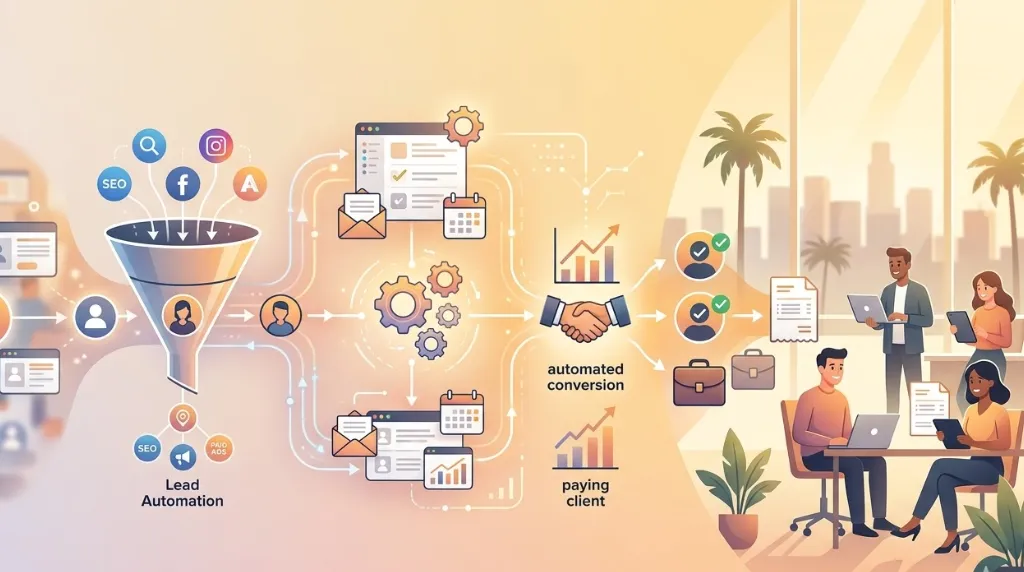
Lead Automation for Digital Marketing Agencies: Converting Website Visitors into Paying Clients with Marketing Automation Software
Digital marketing agencies must efficiently convert website visitors into paying clients. Lead automation streamlines lead capture and nurturing so teams can focus on strategy. This guide explains how visitor tracking, automated nurturing, and marketing automation software support client acquisition. It addresses common challenges and presents best practices to help agencies optimise lead generation. Key sections cover visitor tracking, conversion strategies, and methods to measure the ROI of automation.
How Does Lead Automation Enhance Client Acquisition for Digital Marketing Agencies?
Lead automation improves client acquisition by automating repetitive tasks such as lead capture and follow-up. Automation increases operational efficiency and reduces the risk of losing prospects. It ensures timely, relevant communication with leads, which supports higher conversion rates and better use of team resources.
Research further highlights how AI technologies are reshaping marketing strategies.
AI Automation in Digital Marketing: Boosting Conversion Rates
The research found that AI improves audience segmentation and increases offer personalization, leading to higher conversion rates and a stronger return on investment. Automating routine processes, including administrative tasks and customer support, reduces operational time and improves overall business efficiency.
AUTOMATION IN DIGITAL MARKETING: HOW AI TECHNOLOGIES HAVE CHANGED MARKETING STRATEGIES, YD Gorodetskiy, 2025
What Role Does Website Visitor Tracking Play in Lead Automation?
Visitor tracking supplies the interaction data agencies need to qualify leads. That data supports targeted messaging and improved segmentation. When agencies understand behaviour, they can personalise outreach and prioritise high-value prospects to, increasing engagement and conversions.
How Does Automated Lead Nurturing Improve Conversion Rates?
Automated nurturing maintains timely, personalised contact with prospects using lead scoring and behaviour triggers. Consistent delivery of relevant content builds trust and moves leads through the funnel. Automated reminders and follow-ups reduce drop-off and increase conversion rates.
Which Marketing Automation Software Solutions Best Serve Digital Marketing Agencies?
Agencies should select marketing automation platforms that match their operational needs. Some widely used options are listed below:
HubSpot: Known for its comprehensive features, HubSpot offers tools for email marketing, lead management, and analytics.
Marketo: This platform excels in lead nurturing and scoring, making it ideal for agencies focused on conversion optimization.
ActiveCampaign: With its user-friendly interface, ActiveCampaign provides robust automation capabilities and CRM integration.
Deploying these platforms can improve the efficiency and consistency of lead automation workflows.
What Features Should Agencies Look for in Lead Generation Automation Tools?
Agencies should prioritise specific capabilities when evaluating automation tools:
Integrated Automation Capabilities: Look for tools that seamlessly integrate with existing marketing stacks to streamline workflows.
Predictive Analytics for Lead Quality: Advanced analytics can help agencies identify high-quality leads and tailor their strategies accordingly.
Unified Inbox and CRM Functionalities: A centralized platform for managing leads and communications enhances efficiency and organization.
These features are critical for maximising the impact of lead generation activities.
How Do CRM Integrations Optimize Lead Management and Data Synchronization?
CRM integrations ensure reliable data flow across systems and support automated nurturing workflows. Accurate synchronization keeps lead profiles up to date and reduces manual errors. Integrated systems improve tracking of interactions and enable more informed, timely decisions.
What Are Effective Client Conversion Strategies Using Lead Automation?
To maximise client conversion, agencies can implement several effective strategies:
Automated Follow-Up Sequences: Establishing automated follow-up sequences ensures leads receive timely communication.
AI-Driven Automation Features: Utilizing AI can enhance personalization and improve engagement rates.
Personalized Communication Strategies: Tailoring messages based on lead behavior and preferences can significantly boost conversion rates.
These approaches deploy automation to increase conversion efficiency and move prospects toward purchase decisions.
How Can Personalized Visitor Engagement Increase Conversion Rates?
Personalised engagement delivers real-time, relevant assistance that builds trust. Intervening at critical decision points guides visitors toward conversion. Consistent personalisation improves the user experience and increases the likelihood of long-term client relationships.
What Conversion Rate Optimization Techniques Are Proven for Agencies?
Agencies can employ several proven conversion rate optimization techniques:
Automated Follow-Up Systems: These systems ensure that leads receive timely reminders and relevant information.
Multi-Channel Communication Strategies: Engaging leads across various channels increases the chances of conversion.
Continuous Optimization and A/B Testing: Regularly testing different approaches allows agencies to refine their strategies and improve results.
Applying these techniques systematically leads to measurable improvements in conversion performance.
How Can Digital Marketing Agencies Measure the ROI of Lead Automation?
Measuring ROI requires tracking KPIs that link activity to revenue. Focus on metrics such as lead response time, conversion rate, and engagement. Use A/B tests to validate tactics and map KPI improvements to revenue impact, quantifying automation value.
Which Key Performance Indicators Reflect Lead Automation Success?
Several key performance indicators (KPIs) are critical for measuring the success of lead automation:
Lead Response Time: The speed at which leads are contacted can significantly impact conversion rates.
Conversion Rate: This metric represents the percentage of leads that convert into paying clients.
Customer Engagement Metrics: Tracking engagement levels helps agencies assess the effectiveness of their communication strategies.
These KPIs deliver actionable insights into the effectiveness of lead automation programs.
How Do Case Studies Demonstrate Measurable Results in Client Acquisition?
Case studies document KPI improvements and the practical impact of lead automation implementations. They illustrate ROI with concrete examples and highlight best practices and lessons learned. Well-structured case studies build credibility with prospective clients.
What Are The Best Practices for Implementing Website Visitor Tracking Tools?
Implementing visitor tracking tools effectively requires adherence to proven practices:
Set Up Google Analytics: Establishing a robust analytics framework is essential for tracking visitor behavior.
Regular Monitoring of Traffic and Behavior: Consistent data analysis helps agencies identify trends and optimize strategies.
Ensure Privacy Compliance: Adhering to privacy regulations is crucial for maintaining trust with visitors.
Following these practices strengthens tracking accuracy and supports better decision-making.
How to Integrate Visitor Behavior Analytics Seamlessly with Existing Marketing Stacks?
Automation tools centralise data capture and streamline follow-up processes. Integrations can include setup audits to validate configurations and identify optimisation opportunities. Unified data flow improves lead nurturing and overall marketing performance.
What Are Common Challenges and Solutions in Visitor Tracking Implementation?
Agencies often face several challenges when implementing visitor tracking tools:
Data Synchronization Issues: Ensuring data flows seamlessly between systems can be complex.
Data Quality Problems: Maintaining accurate and reliable data is essential for effective tracking.
Privacy Compliance Complexities: Navigating privacy regulations can pose challenges for agencies.
Resolving these issues requires a structured approach, strong data governance, and the right integration tools.
How Can Agencies Continuously Improve Lead Automation Strategies?
Continuous improvement relies on a few core practices:
Track Key Performance Indicators: Regularly monitoring KPIs helps agencies identify areas for improvement.
Utilize A/B Testing for Strategy Refinement: Testing different approaches allows for data-driven decision-making.
Regularly Review and Adjust Automation Strategies: Adapting strategies based on performance data ensures ongoing effectiveness.
These routines enable agencies to refine tactics and maintain a competitive advantage.
What Role Does Regular Audit and Monitoring Play in Automation Effectiveness?
Regular audits identify automation gaps and surface optimisation opportunities. Ongoing monitoring tracks KPI trends and supports prioritized action plans. This disciplined process keeps automation aligned with business objectives and maximises ROI.
How Do Emerging Trends Like AI-Driven Lead Scoring Impact Future Automation?
AI-driven lead scoring uses predictive analytics to prioritise high-value prospects. This improves resource allocation and focuses human effort where it has the greatest impact. The trend points to more efficient, data-led lead management and higher conversion potential.
The strategic application of AI in lead management is accelerating measurable improvements in conversion performance.
AI for Automated Lead Generation & Conversion Optimization
By automating lead handoff rules, businesses can prioritise leads and dedicate time to high-value prospects, thereby optimising conversion rates.
The Role of Artificial Intelligence in Automating Lead Generation, 2025
To further enhance your lead automation strategies, consider exploring Sertbo's comprehensive solutions.
For a comprehensive evaluation of your current lead generation processes, consider a free audit to identify areas for improvement.
Frequently Asked Questions
What are the best practices for integrating marketing automation software?
Prioritise seamless connectivity between tools to avoid data silos. Test integrations thoroughly before launch and provide team training to ensure effective use. Monitor performance regularly and make configuration adjustments as issues emerge.
How can agencies effectively segment their leads for better targeting?
Segment leads by criteria such as demographics, behaviour, and engagement. Use analytics to identify patterns and apply lead scoring to prioritise outreach. Tailor messaging and content for each segment to increase relevance and conversion.
What role does A/B testing play in optimizing lead automation strategies?
A/B testing verifies which messages and workflows perform best. Test variables like email content, subject lines, and calls to action. Use results to make data-driven adjustments and scale the most effective approaches.
How can agencies maintain a balance between automation and personal touch?
Use automation for routine tasks while reserving personalised outreach for high-value leads. Incorporate behavioural triggers to insert human touchpoints when they matter most. Review automated content regularly to keep it relevant and engaging.
What emerging technologies should agencies watch for in lead automation?
Watch developments in artificial intelligence, machine learning, chatbots, and natural language processing. These technologies enhance lead scoring, predictive analytics, and personalised interactions. Adopting them can improve efficiency and engagement.
How can agencies ensure their lead automation strategies are scalable?
Choose flexible, modular software that grows with the business. Standardise processes that can be replicated across campaigns. Regularly review performance metrics and adapt strategies as volume and complexity increase.
Conclusion
Lead automation is a strategic requirement for agencies seeking to convert visitors into loyal clients. Optimised nurturing and visitor tracking improve communication and raise conversion rates. Data-driven insights from automation tools enable targeted refinements that prioritise high-value leads. Consider our solutions for modernising and scaling your lead-generation efforts.
